-
Picnic 2016 – a FUN time!
The Chattahoochee Valley Beekeepers Association annual picnic was again held at the farm of Betty Beegle and her family. At their farm, they are ready for anything and luckily they were ready for rain. Yes, it rained on our picnic, but that just made it fun, interesting and memorable. At the Beegle Farm, they have a large framed roof over their picnic area, so all the food and guests were covered. You had to get a little rained on to get your dessert, but that didn’t stop anyone. It was well worth it too because all the food and all the desserts were terrific.
Before it rained, we did a little candle dipping and also saw a wax melter setup. Along with this, Jim Ellis and Freddie Beegle got into one of Freddie’s hives and did an inspection demonstration. This is always very informative and a great thing to see especially since we should all do hive inspections before winter to make sure the bees are putting up enough honey. The smoker contest and the honey tasting contest also took place. This year the smoker contest was divided into large smokers and smaller smokers with a prize for each category. The winner of the smaller smokers was Charlie Brown. The winner of the larger smokers was Duane Johnson again. Congratulations to you both! The winner of the honey tasting contest was William Ferris for the second year in a row. Congratulations! We also had a new attraction at the picnic this year. D. Dekeyser brought one of his parrots named Scooter. This extremely beautiful bird was quite entertaining and was a big hit with the kids as well as the adults.
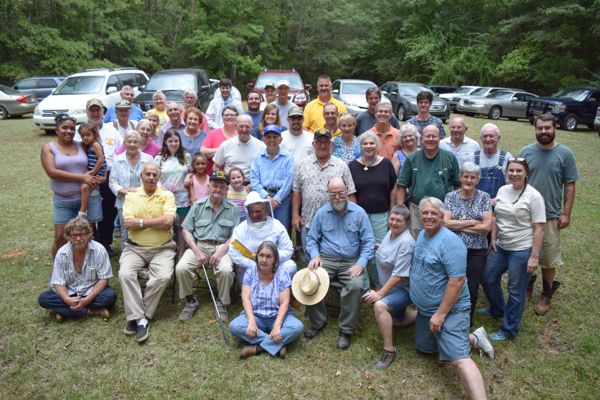 Here is a group photo which we took just in the nick of time before it began to rain. Thank you to Doug Roberts for taking our group photo and also all of the photos on our photo page. Here is a quick link to see these photos… /?page_id=289
Our October meeting will be at the UGA Extension office on October 10, 6PM.
-
Annual Picnic for 2016!
The CVBA Annual Picnic is scheduled for Sunday September 11, 2016
Picnic location is the Beegle Farm – more interesting facts on that later in this post.
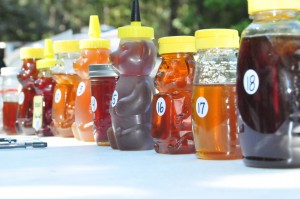 Many activities – beginning at 4:30 PM
Dinner, Fellowship, Beekeeping Technique Demonstration, Honey Tasting Contest, Smoker Contest, Candle Making, Group Photo, and a Special Surprise! So, bring your family, bring a veil for the demo, a small un-marked squeeze top container of your best honey for the tasting contest, your smoker for the smoker contest… don’t bring pine straw, everyone will pick from the same pile, and of course bring your favorite food to share.
Partial reprint from previous years:
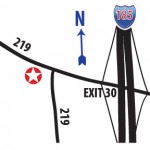 Anyway, I promised some interesting facts on the Beegle Farm. First, here is a basic map on how to get there. The big double road drawn North/South in the map on the right, is Interstate-185. Take Exit 30, then go a very short distance toward 219. Whether you turn right or left obviously depends on if you are travelling North or South on 185. The off ramps are technically on the Hopewell Church Road, but Hopewell Church Road turns into 219, so you do not turn once you are on that road. You are within walking distance… pass a church, and when you come to some trees on the left, you have arrived. Look for the “If and When Honey” sign, and usually there is a smaller sign that says “Bee Club” pointing down the dirt road that leads to the picnic area, shown as the red circle with the star on the map.
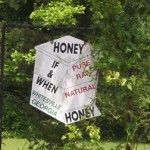 The Beegle Farm is a historic landmark with a rich history, which includes a grist mill, power plant, and general store. Bet you didn’t know that! I happened upon this website http://www.angelfire.com/electronic2/ronrollins/page1.html describing several interesting, historic landmarks in the Whitesville, GA area. The Beegle Farm is one of the featured places, and to me, the most interesting. In 1932 Betty’s father, J.T. Cox, purchased the house, land, grist mill, and country store. I will let you read the details from the link above, but interestingly he also owned a personal power plant that produced 32 Volt electric power – enough for their needs on the farm (back then). The grist mill ran on it’s own separate gasoline engine until they converted it to run with electricity. This personal power plant also provided electricity for a movie projector, which J.T. ran during the summer months. Picture a drive-in, with wagons instead of cars. This movie night attracted quite a number of people, who, in-turn, could all purchase snacks at intermission from the country store… how smart is that?
So plan to attend this year’s picnic. It’s always a fun time
-
Founding Member’s 90th Birthday
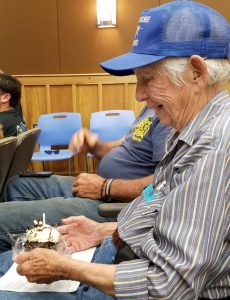 June 14th marked the 90th birthday of one of our founding members, Betty Beegle. The Chattahoochee Valley Beekeepers Association is proud to have Betty as an active board member as well as an active beekeeping member. At the June 13th meeting, her birthday was announced and her mentorship honored by member D. Roberts. President P. Berry presented Betty with a delicious looking birthday cupcake, which prompted singing “Happy Birthday” and a huge round of applause by all.
Betty’s father started “If & When Honey” in Whitesville, GA when she was a teenager. This is still run on an honor system. The CVBA holds their annual picnic at her farm. To read more, check out this post from 2012.
Reaching a 90th birthday is a rare milestone especially in good health. Betty celebrated her birthday at Callaway Gardens with a crowd of family members and by getting her drivers license renewed!
-
Neonicotinoids – Colony Collapse – Local Home Depot
Guest Contributor: Doug Roberts from Grayhill School Farm.
What are Neonicotinoids? Why should we all be concerned, upset, outraged? If you don’t read any further, read this: Neonicotinoids are a LEGAL (now in 2016) insecticide that has been linked to honeybee colony collapse.
First of all, this topic is not new, this group of chemicals is not new and the information and concerns about the findings are not new. Government action on this topic is moving at glacier speed. Moving, yes…quickly, no. You should be aware of this information and keep yourself knowledgeable. It effects YOU.
Neonicotinoids are a specialized systemic agricultural insecticide resembling nicotine. Systemic means that it is actually in the plant. Many are water soluble so they can be taken up by the plant as it grows. The first commercial use was as a seed coating. You probably remember seeing corn seed coated with a pink powder. There are several “varieties” of neonicotinoids including Nitenpyram, Dinotefuran, Thiacloprid, Acetamiprid, Clothianidin, Thiamethoxam and Imidacloprid. Invented back near the 1970’s and coming under scrutiny back in the 1990’s, these chemicals have been used all over the world. Eighty percent of all seeds in 2008 were treated with neonicotinoids.
In 2008, the link to colony collapse became more prominent when a planted cornfield undeniably poisoned a massive amount of nearby honeybees in Germany. Germany suspended use, followed by France and Italy. The U.S. did not. Again, a 2012 study found thiamethozam and clothianidin (both neonicotinoids) in dead bees in agricultural settings. Some bees still alive had tremors and convulsions both indicating poison. Tests also proved that corn pollen foraged by bees tested positive for neonicotinoids. Recent research establishes toxicity for both honeybees and other beneficial insects even with very low levels of contact.
In 2013 almost all corn in the US was treated with either clothianidin or thiamethoxam. And a year later the soybean growers joined in along with cotton and sugar beets. Now, soybean growers are using the most neonicotinoids of any major crop. Yes, increasing use, not decreasing! Bayer Cropscience and Syngenta are two major manufacturers of neonicotinoids whose names you probably recognize. So, the U.S. continues to allow use… why? The U.S. Environmental Protection Agency (EPA) operates a 15-year review cycle for all pesticides… let that sink in… 15 years!
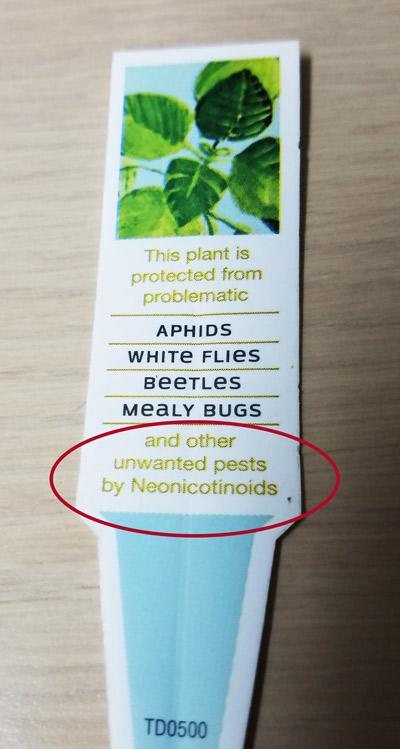 But there’s more. These chemicals are not limited for use by commercial growers. Many plants and seeds sold to consumers are treated as well as the availability of “consumer use” insecticides for purchase. Locally, (in 2016) we found tags on plants in Home Depot labeling the plant as being treated with neonicotinoids. Specifically, one of the plants was a Butterfly Bush, a pollinator attracting plant! (A Butterfly bush is not usually susceptible to invasive insects anyway.) So, a plant purchased specifically to provide forage for pollinators may actually be doing harm. The tags found were not prominent. Apparently, Home Depot requires plants treated with neonicotinoids be labeled as such, but the company continues to sell them. How many plants are available to buy nationwide that are not labeled? There is no law that consumers must know the plant has been treated with a systemic insecticide. Still, Home Depot is knowingly selling neonicotinoid infused plants.
Although small, Maryland, on a state level, in April of 2016, has restricted the use of insecticides “by consumers” containing neonicotinoids. A partial ban is better than no ban. Maryland has at least recognized the problem.
The EPA is evaluating this insecticide group and is said to release its findings in 2018… like I said, glacier speed.
Please research this topic on your own, read labels, check tags and hopefully choose NOT to buy neonicotinoid products, plants and seeds.
HELP! Swarms & Bee Rescue
Announcements
Recent Posts
- Picnic 2016 – a FUN time!
- Annual Picnic for 2016!
- Founding Member’s 90th Birthday
- Neonicotinoids – Colony Collapse – Local Home Depot
- Inmark for bottling
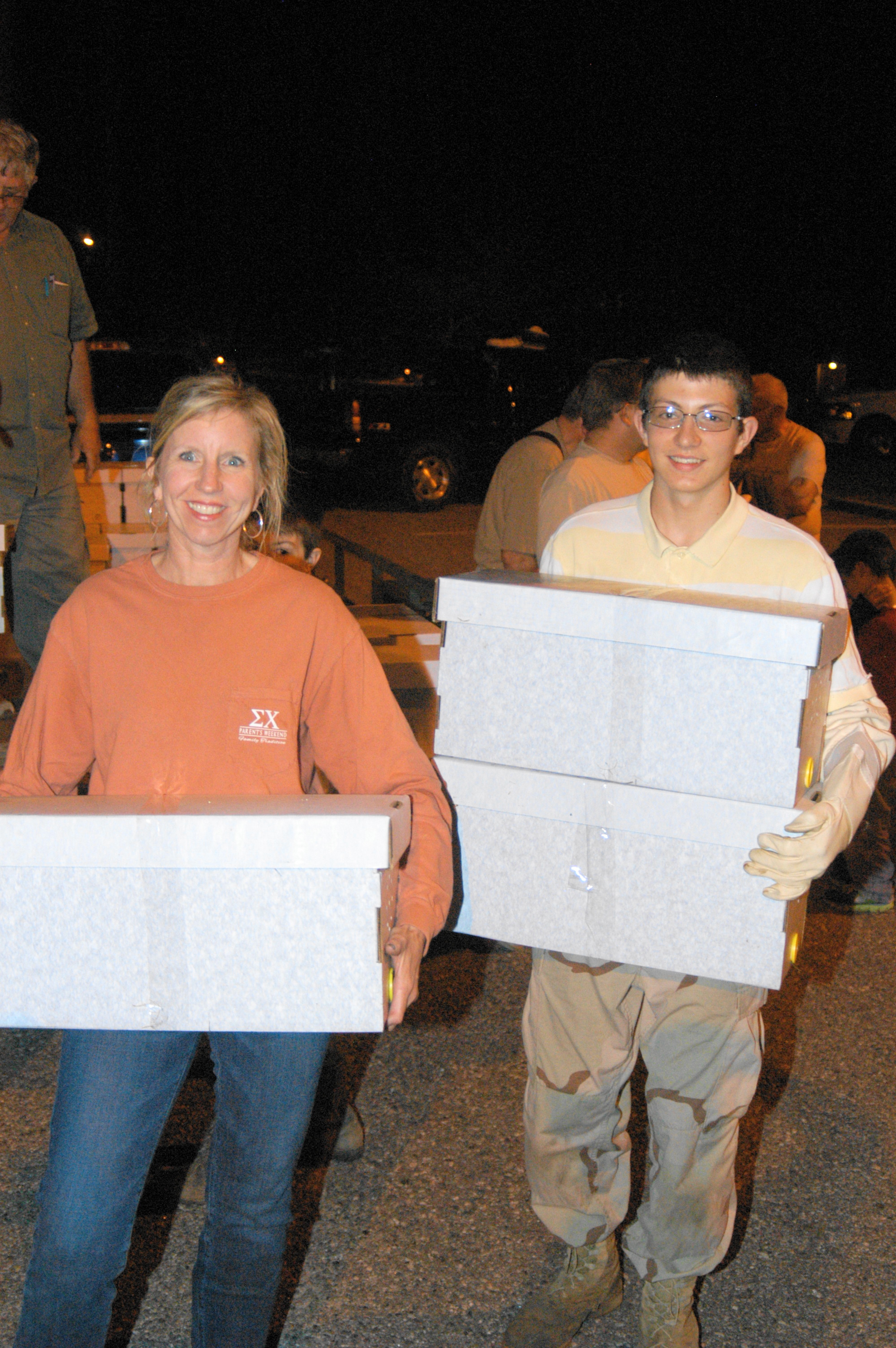
Nucs Arrive 2015
Varroa Mite Test
Helpful Links
Archives
- September 2016
- August 2016
- June 2016
- May 2016
- April 2016
- December 2015
- October 2015
- August 2015
- July 2015
- June 2015
- April 2015
- March 2015
- February 2015
- December 2014
- October 2014
- September 2014
- August 2014
- July 2014
- June 2014
- March 2014
- January 2014
- September 2013
- August 2013
- July 2013
- June 2013
- April 2013
- March 2013
- January 2013
- November 2012
- August 2012
- July 2012
- June 2012
- May 2012
- April 2012
- March 2012

